Hydrogen is a recognized, recyclable, and new clean energy source with the greatest potential to replace oil. Proton exchange membrane fuel cell (PEMFC) technology achieved significant breakthroughs in the 1990s. With advantages such as zero emissions, low operating noise, high efficiency, high energy density, and fast startup, it has gained widespread application in vehicles (such as cars), drones, and submarines. Green hydrogen production is also a key component of gas recycling, with the reactor being its primary equipment.
Bipole plates are core components of hydrogen energy cells and green hydrogen production reactors. They offer excellent conductivity, high strength, thin thickness, small size, low cost, light weight, ease of forming and mass production, and excellent overall performance. As a core component of fuel cells, the dimensions and precision of ultra-thin bipolar plates are crucial factors affecting battery quality, power, size, and cost.
Currently, domestic companies generally use general-purpose presses such as hydraulic presses and conventional punch presses to produce bipolar plates. However, hydraulic presses have low production efficiency, high energy consumption and production costs, and are prone to oil leakage, causing pollution to stamped parts and the environment, making them unsuitable for large-scale production. Conventional punch presses also suffer from poor machining accuracy, prone to workpiece cracking, high scrap rates, low efficiency, and high noise levels. Servo closed-type multi-link presses for bipolar plate forming balance process requirements and production efficiency, significantly shortening new product development cycles. They offer higher efficiency, precision, and intelligence, lower noise levels, and more energy-efficient production processes, improving quality and reducing costs. Therefore, to adapt to the rapid development of the new energy market, it is necessary to develop a corresponding group standard for servo closed-type multi-link presses for bipolar plate forming to meet market development needs.
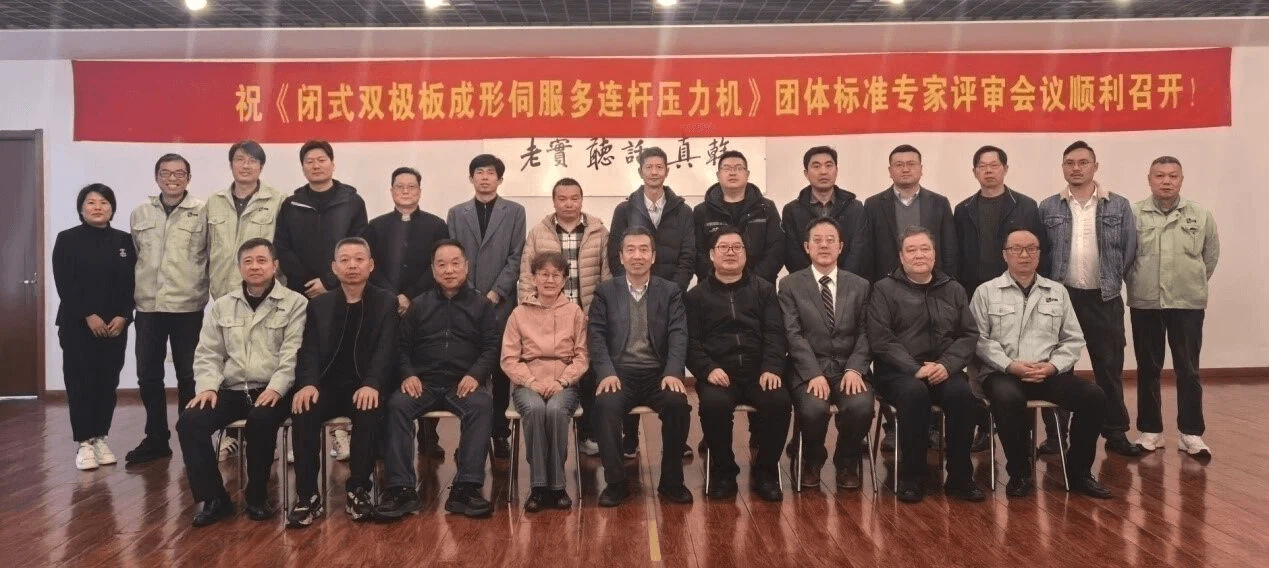
In 2025, the expert review meeting for the group standard "Servo Multi-Link Presses for Closed-Type Bipolar Plate Forming," organized by the Standards Working Committee of the China Forging Association, was successfully held in Liyang.
Mr. Han Mulin, Vice President of the China Forging Association and Chairman of the Standardization Committee, introduced the significance and role of standard development and the progress of the association's group standards. He noted that the development of the "Closed Bipolar Plate Forming Servo Multi-Link Press" group standard actively responded to national policy requirements, improved and enhanced the standard system's support, enhanced the level of intelligent manufacturing, and provided a strong basis for the transformation and upgrading of the forging industry. Mr. Sun Yuanguo stated that the development of relevant group standards is of great significance for regulating the market, improving product quality, and promoting the healthy and orderly development of the industry.
The experts who served on the expert review panel included Mr. Xie Bin of Nanjing Kangni Precision Machinery Co., Ltd., Ms. Xue Jier of the China Foundry Association, Mr. An Guangming of the China Forging Association's Standardization Committee, and Professor Du Ren of the China Forging Association's Standardization Committee.
Over ten organizations participated in the drafting of this standard, including the Punching Division of Goanwin Group.
At the review panel, Engineer Li Jiangguo reported on the preparation instructions, document content, and the results of the public comment phase.
The meeting conducted a detailed discussion of the standard's drafting instructions and text. Following questioning and discussion by the expert group, the following consensus was reached:
• This standard, for the first time, covers the types and basic parameters, technical requirements, accuracy, test methods, inspection rules, packaging, transportation and storage, on-site installation and commissioning, and maintenance and servicing of closed-loop bipolar plate forming servo multi-link presses.
• The presses covered by this standard are key targets of national special projects for industrial base reconstruction and high-quality development of the industrial machine manufacturing industry. The development, implementation, and promotion of this standard will lay a solid foundation for the standardized, efficient, green, and energy-saving production of high-precision bipolar plates and other non-ferrous metal and steel sheet products. This is the first group standard for closed-loop bipolar plate forming servo multi-link presses, filling a gap in industry standards. The standard's technical level is leading domestically, and some indicators reach internationally advanced levels. The standard was unanimously approved by the participating experts. The drafting group will revise and improve the standard based on the expert opinions and submit it to the China Forging Association for approval and publication.
The meeting was chaired by Sun Jiaojiao, Secretary-General of the Standards Working Committee of the China Forging Association.